Hi. I have one more question.
When I request forecast data, there is solar radiation data at night time (around 20:00) even the sunset time is around 18:30.
Why it occurs?
Hi. I have one more question.
When I request forecast data, there is solar radiation data at night time (around 20:00) even the sunset time is around 18:30.
Why it occurs?

Thank you for your question. Whilst direct ('beam') radiation does go to zero almost immediately at sunset, scattered radiation will persist for a period after sunset. This scattered radiation explains why it is not immediately dark at sunset. This radiation can persist for some time depending on the requested location and time of year.
In addition, solar radiation is a 'backwards looking' weather element - it is the average radiation that occurred during the previous hour to the time reported and so for hours soon after sunset, there can be an overall average radiation that occurs for a number of hours.
In your case, if it was somewhat light at 19:00 (the start of the hour that is reported at 20:00) due to the twilight after sunset at 1830 then a non-zero number of solar radiation is expected.
However, if the number reported at 20:00 seems too high for a twilight period, please let us know the exact location being queried and we will be happy to investigate.
Regards
Visual Crossing Support

Thank you for your explanation. It was really easy to understand for me. I checked again and found that solar radiation and solar energy reported till 22:00. It seems to be strange for the location I requested (latitude: 34.9544, longitude: 135.6684) in all season.
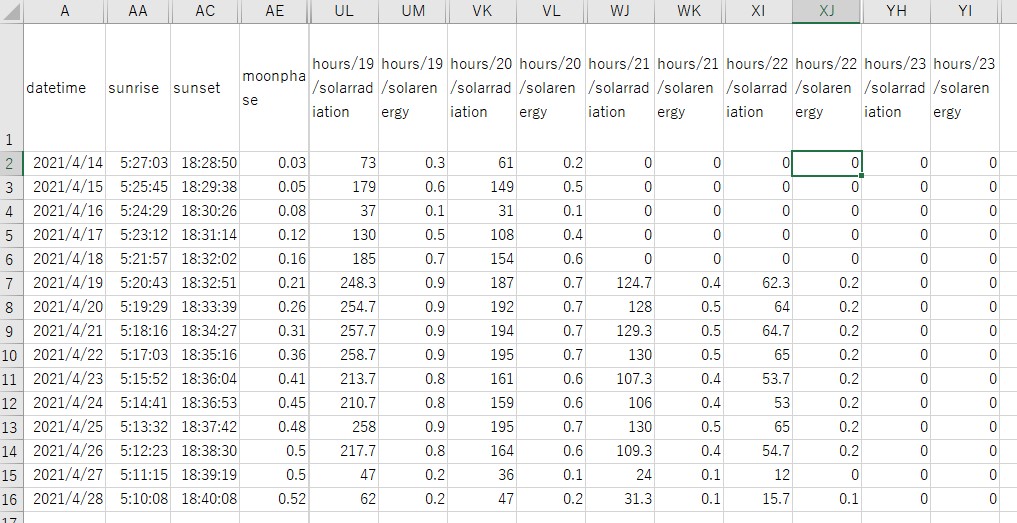
All non-zero number of solar energy (MJ/m2) reported by the local meteorological observatory near the location (Osaka, JA) for the last week end at 19:00.
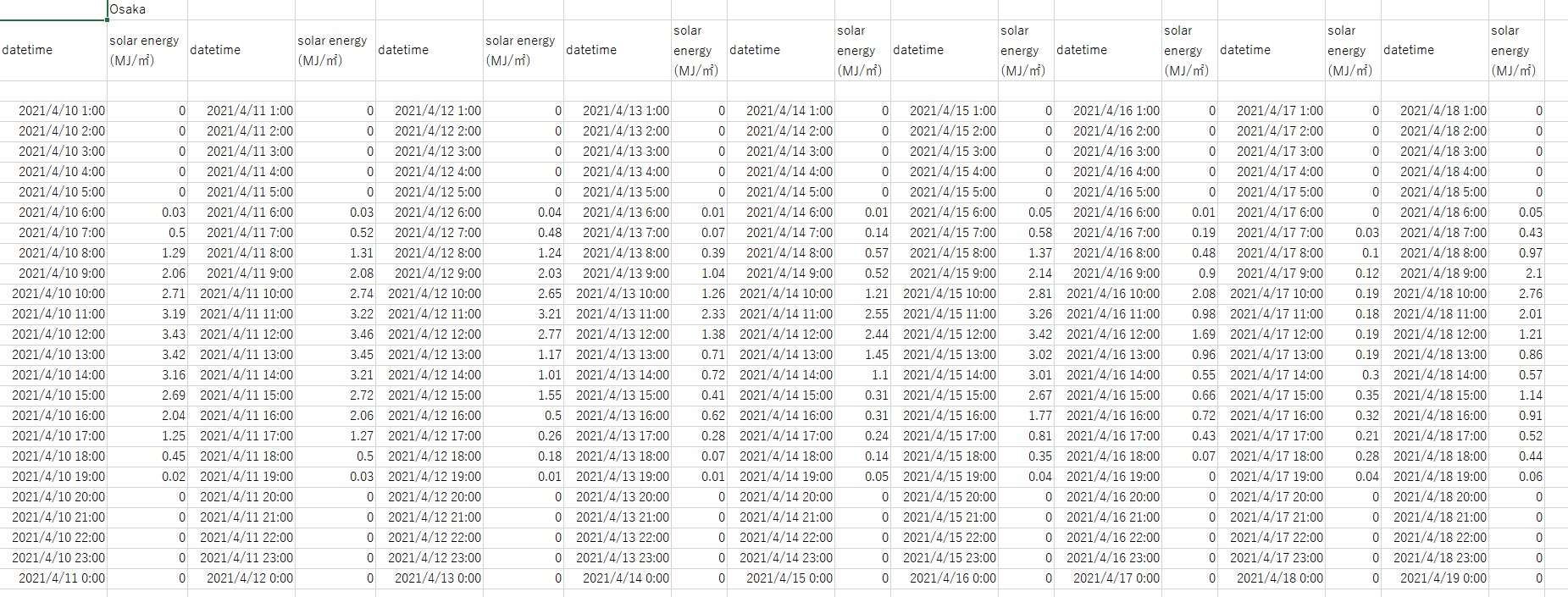
Would you please check and investigate?
Thanks for the information! We have opened a ticket for our engineers to investigate further.
Regards
Visual Crossing Support